


Luggage Capacity for Tour Buses: What Fits Under the Coach

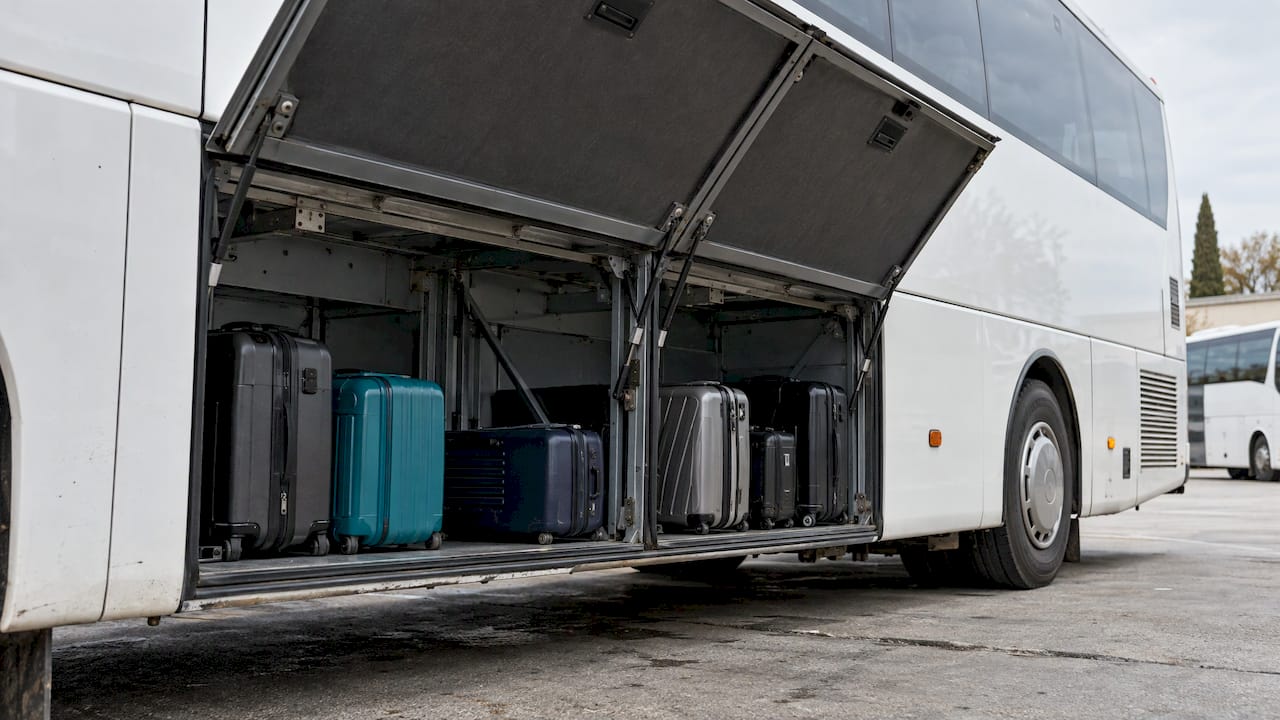
A full-size tour coach carries roughly 10 to 13 cubic meters of luggage in its hold, enough for about one suitcase per passenger. A minibus has far less space, so the vehicle should be chosen by passengers and bags together. This guide shows how to read the figures, estimate what your group needs and avoid the surprise at the curb when the hold is full. If you are planning group transport in Iceland, we at Tripiceland build the vehicle choice around both numbers: seats and suitcases.
TL;DR
Modern 12 to 14 m coaches list a luggage hold of about 10 to 13 m³, which manufacturers equate to roughly 200 liters per passenger.
Seats and luggage space do not scale together: a longer coach adds both, but a double-decker adds seats faster than hold volume, and an electric coach can have a smaller hold.
A standard suitcase of 80×50×30 cm takes about 120 liters on paper, so a hold is a puzzle of shapes, not just a volume.
Count bags, not people: a group with ski gear, strollers or trade-show cases needs a bigger vehicle or a second one.
Tell the operator your bag count and sizes when you ask for a quote, not on the day.
Table of Contents
What a tour coach hold actually holds
Manufacturers publish luggage volume in cubic meters. One cubic meter is 1,000 liters, so the numbers translate easily into suitcases once you know the size of your bags.
Here is what the makers state for current long-distance coaches:
Coach | Seats (stated) | Luggage volume (stated) |
up to 55 to 63, by length and doors | up to 10.5 m³ hold plus 1.8 m³ inside racks, 12.3 m³ in total | |
53 to 63, by version | up to 12 m³ (53 and 57 seats), up to 13 m³ (59 and 63 seats) | |
up to 85 | up to 11 m³ |
Two things stand out. First, the Evadys brochure puts its 12.3 m³ at an average of 200 liters of luggage per passenger, which is a useful rule of thumb for any coach of this class. Second, the double-decker carries up to 85 passengers but has a hold of only up to 11 m³. Fill it to the last seat and each passenger gets noticeably less space than on a single-deck coach.
Part of the Evadys figure sits in racks inside the cabin. Racks are for soft bags and jackets, not for a rigid suitcase. When you count suitcases, the underfloor hold is the number that matters.
From cubic meters to suitcases
A volume figure does not tell you how many bags fit, because suitcases are boxes with wheels and handles, and gaps are lost space. Still, a quick calculation shows the scale.
Take a hold-size suitcase of 80×50×30 cm, the standard hold baggage size one Italian intercity operator lists, together with a 20 kg limit. That is 0.8 × 0.5 × 0.3 = 0.12 m³, or 120 liters.
On paper:
A 10.5 m³ hold fits about 87 of those suitcases in theory.
A 50-passenger group with one suitcase each needs about 6 m³, so it fits with room to spare.
A 55-passenger group with one large suitcase each and one oversized item every fifth person approaches the limit of a mid-size hold once you allow for awkward shapes.
The point of the exercise is the margin. Real holds have wheel arches, a spare-wheel bay, side doors that limit how deep you can reach and a loading order that matters. Plan to use well under the theoretical maximum, and you will never be the group repacking bags at the roadside.
Minibuses: fewer seats, a very different luggage picture
A minibus does not have a deep underfloor hold like a coach. Luggage usually shares space with the passenger area or sits in a rear section, so every extra suitcase can cost a seat’s worth of room. The result is that a minibus filled with passengers may carry fewer bags per head than a coach, even though it feels roomy.
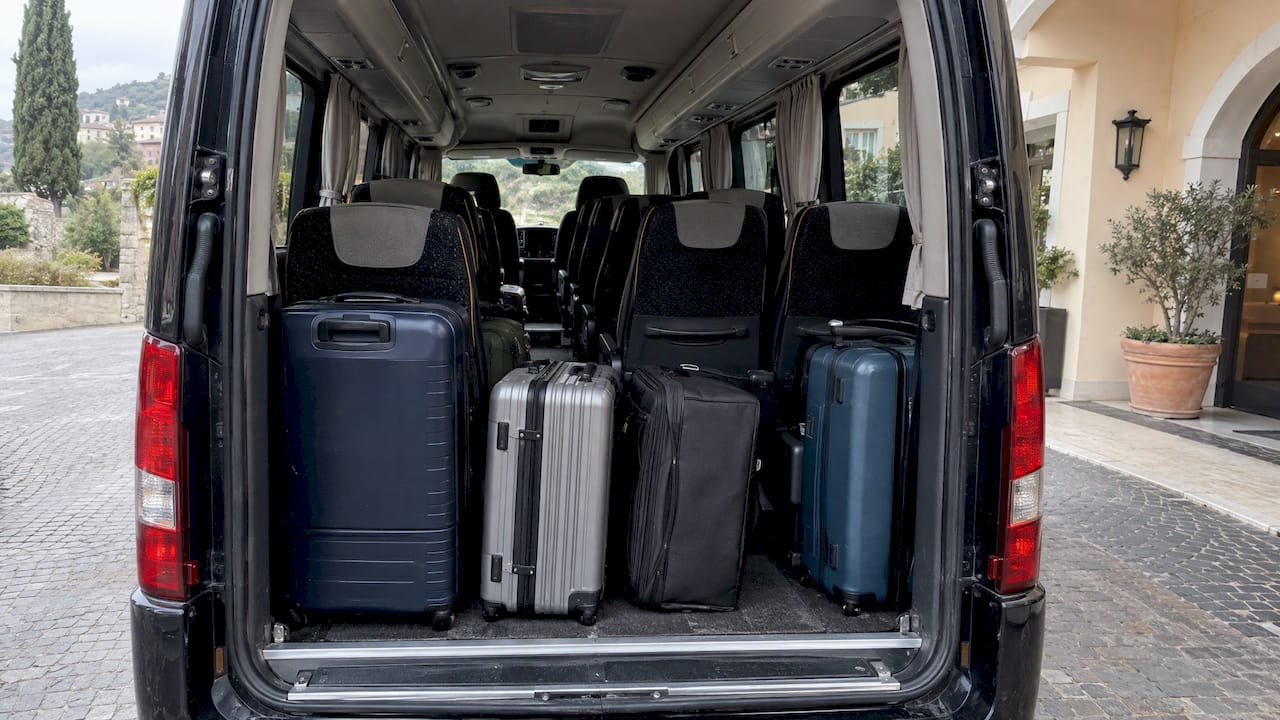
This is the case where seat count misleads. A group of 16 people with big suitcases may be better served by a larger vehicle than the seat count alone suggests, while a group of 16 with cabin bags only fits a minibus easily. Our fleet runs from small vans to large coaches, with categories from 1 to 8, 10 to 22 and 21 to 48 passengers, so the right size can follow the bags as well as the headcount. For the seat side of the decision, see our guide on what size bus to pick for group travel, and for the trade-off between the two vehicle types, minibus hire versus coach hire in Iceland.
What eats into the space you have
Seat layout and length
Longer coaches add both seats and hold. In the Neoplan Tourliner range, hold volume rises from up to 12 m³ in the 53-seat version to up to 13 m³ in the 59 and 63-seat versions, across lengths from 12,113 mm to 13,913 mm. The extra length is mostly extra seats, so hold per passenger stays similar.
Seat layout inside the coach changes comfort, not the hold. Still, it helps to know how many rows you really need, and our guide to coach seating layouts walks through that.
Electric coaches
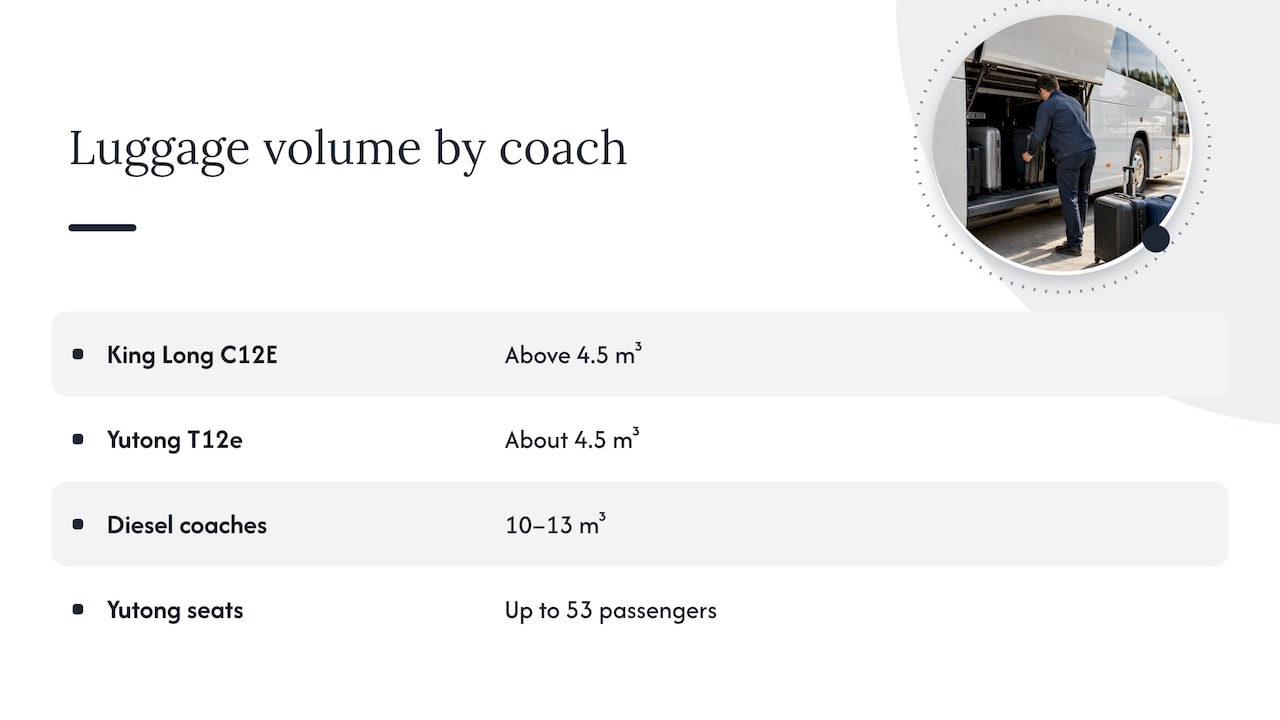
Battery placement can shrink the hold. In a 2026 comparison of electric tour coaches, Autobusweb reports that the King Long C12E has luggage compartments above 4.5 m³ and the Yutong T12e about 4.5 m³, with the Yutong seating up to 53. That is well under half of the 10 to 13 m³ diesel figures above, for a similar number of seats. If an electric coach is on the table, ask for the hold volume of that exact vehicle, not the class.
A related point: loose batteries in your own bags, such as power banks and spare camera cells, have their own handling rules. The lithium battery shipping rules explain why batteries are treated as restricted goods, which is useful context when a group packs a lot of electronics.
Luggage the group did not mention
The biggest variable is the bags nobody counted. Strollers, tripods, camera cases, banners for an event, golf bags, hiking poles and last-minute shopping all compete with suitcases. For a corporate trip or an event shuttle, the equipment often takes more room than the people’s clothes.
Why public bus allowances are not a guide to a private coach
Most search results for this topic are about line buses, where each operator sets its own limits. Autolinee Toscane, the Tuscan public transport network, allows one free item per passenger up to 105 cm total dimensions and 10 kg. Bigger items up to 150 cm and 20 kg can go in the hold only if there is room, at a fare equal to the route fare, and may be refused on an overcrowded bus. Italy on Foot reports that other coach operators set different limits, including two hold bags with a combined 140 cm and 12 kg each, and that drivers can turn away unbooked oversized items when the hold is full.
The lesson for a private group is the opposite of the line-bus experience. On a scheduled service you hope there is room. On a private charter you decide the room in advance, because the vehicle is yours for the trip. The conversation that matters happens before booking, when the bag count and sizes can shape the vehicle.
How to estimate what your group needs
Use this routine for any group tour, school trip, company outing or family reunion.
Count bags, not people. Ask each person or group leader for the number of hold bags, cabin bags and special items.
Note the biggest items. Check the largest suitcase and anything that cannot be stacked: strollers, instruments, sports gear.
Convert to volume. Use 120 liters for a large suitcase as a ceiling, and compare the total with the hold volume of the vehicle. Leave generous margin for the gaps between bags.
Check the weight too. A fully loaded hold is heavy, and 20 kg bags add up quickly across 50 passengers.
Plan the route. If the group stops at several hotels, bags may need to come out in order, which affects how they are loaded.
Decide the fallback. If bags exceed the hold, a second vehicle or a larger coach is cleaner than leaving a few bags in the aisle.
Where this goes wrong is step 1. Groups tell the organizer 40 passengers and say nothing of the cases of equipment. We ask for the bag count when we plan the itinerary with you, so the vehicle is picked for the full load rather than for the seats alone. For groups deciding between one big coach and several smaller vehicles, charter bus versus multiple taxis in Iceland covers what a single vehicle keeps together.
Worked example: a 45-person corporate group
A company brings 45 guests to Iceland for four days. Each guest has one large suitcase, and the organizers add two roll-up banners, three cases of presentation gear and a box of gifts.
45 large suitcases at 120 liters each: 5.4 m³ on paper.
Event equipment: perhaps 1 m³ with awkward shapes.
Total: about 6.4 m³ on paper, against a coach hold stated at 10 to 13 m³.
That looks comfortable, but the shapes and the need to load in the right order make it sensible to treat this group as a coach case, not a minibus case. Splitting into two 22-seat vehicles would give each a smaller hold, so the single coach is the safer fit. If half of the guests bring ski bags or camera trunks, the margin shrinks and the conversation about a second vehicle starts early.
Do tour buses have bathrooms?
Some long-distance coaches have an on-board toilet, but it depends on the vehicle, and it is a feature to confirm per vehicle. On the luggage side, an on-board toilet and its tank take space on the vehicle, so the layout is another reason to ask for the exact vehicle’s specifications. On most Icelandic sightseeing days, planned stops at facilities are part of the itinerary, which we build with you when planning the route.
Our view on luggage and vehicle choice
Most people ask us about seats first. Luggage is the question that decides whether a day starts calmly or with a rearrangement at the curb. Our approach is to plan the trip from the group’s full load: people, bags and any equipment. We work with vehicles from small vans to large coaches, and custom itinerary planning is part of the service, so the vehicle can follow the real needs of the trip rather than the headline passenger number. For travel agents, corporate clients and event organizers, that means one conversation about numbers at the quote stage, and a vehicle that is ready on the day. For families, it means that the stroller and the extra suitcase are not a problem to solve at the airport. Malik
Plan your group’s transport with Tripiceland
We offer bus and minibus rental with drivers for private tours, day trips, airport transfers, group transport and event shuttles in Iceland. Send us the number of passengers, the number and type of bags and your route, and we will propose the vehicle that fits all of it.
See the fleet by passenger category or go to Tripiceland to request a quote for your group.
FAQ
How much luggage can a tour bus carry?
A full-size coach has a hold of roughly 10 to 13 m³ according to the manufacturers’ own figures, which one maker equates to about 200 liters per passenger. In practice that is about one large suitcase per seat plus hand luggage. The exact number depends on the vehicle and the shape of the bags.
How many suitcases fit in a coach hold?
A standard 80×50×30 cm suitcase takes about 120 liters, so a 10.5 m³ hold would fit around 87 on paper. Real loading leaves gaps, so plan on fewer. Tell us your bag sizes and we will check them against the vehicle.
Does a minibus carry less luggage than a coach?
Usually yes in relation to its seats, because a minibus has no deep underfloor hold and luggage shares space with passengers. A group with large suitcases may need a bigger vehicle than its headcount suggests. We can match the vehicle to your seats and bags together.
What is the seating capacity of a tour bus?
Single-deck long-distance coaches seat roughly 53 to 63 passengers depending on length, and a double-decker can reach up to 85. Smaller vehicles cover groups from a few people to 22 and more. Our fleet is organized in passenger categories to make the choice simple.
Sources
Recommended

Comments